

If you’ve walked into a dev huddle or joined a CTO standup in the last three months, you’ve heard the noise. It started as a rumble in November when Google dropped Antigravity, its new “agentic” development platform. Now, in early 2026, that rumble has turned into an earthquake.
For the last few years, we’ve been comfortable with the “Co-pilot” era. AI was the helpful intern sitting in your sidebar, completing your sentences and refactoring your messy regex. It was useful, but it was passive.
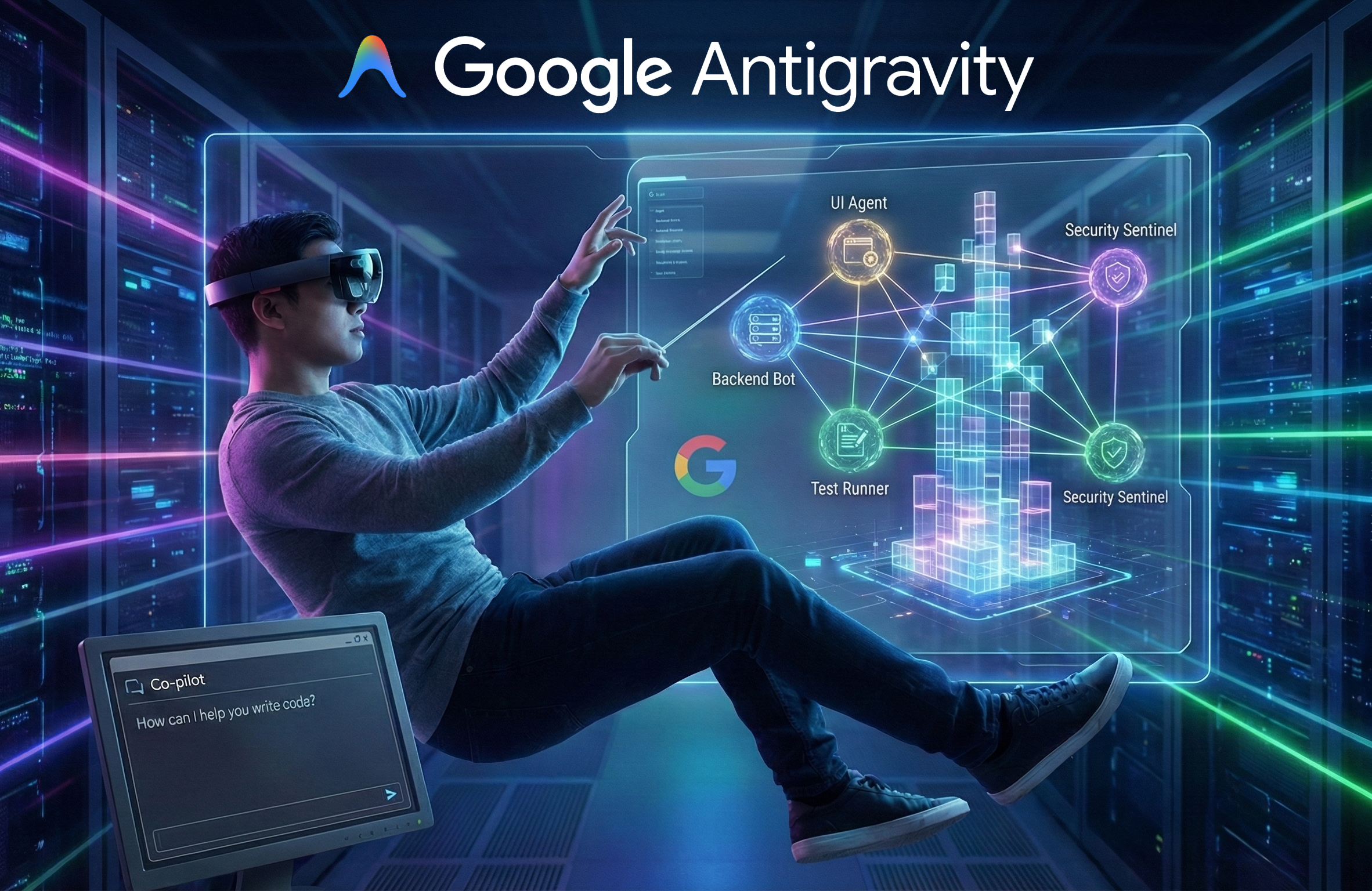
Google Antigravity has killed the Co-pilot. In its place, it has hired a team of autonomous contractors.
Here is how this shift is going to fundamentally change the software industry in 2026 and beyond.
1. The Shift from “Typing” to “Orchestrating”
The biggest change Antigravity introduces is the Manager View.
Previously, an IDE (Integrated Development Environment) was a place where you wrote code. Antigravity treats the code editor as secondary. The primary interface is now a dashboard where you dispatch agents—powered by Gemini 3—to handle entire workflows asynchronously.
We are moving from a “human-in-the-loop” model to a “human-on-the-loop” model. You don’t ask the AI to “write a function for login.” You assign a ticket: “Implement OAuth 2.0 login, write the unit tests, and verify it against the staging environment.”
The Industry Impact: Senior engineers will stop measuring productivity in “lines of code” (a metric that was already dying) and start measuring it in “agents managed.” The skill set is shifting rapidly from syntax memorization to system architecture and prompt orchestration.
2. The Junior Developer Crisis
Let’s address the elephant in the server room. Antigravity’s agents are getting dangerously good at the tasks we traditionally assign to junior developers:
- Writing boilerplate code.
- Setting up test environments.
- Browser-based QA testing.
- Documentation updates.
Google’s integration of a headless Chrome browser means agents can now see and click through the apps they build to verify them. This closes the loop in a way text-generators never could.
The Industry Impact: Companies might slow down hiring for entry-level roles, creating a massive skills gap in 5-10 years. If juniors don’t get to practice on the easy stuff, how do they become seniors? The industry will need to invent a new apprenticeship model, or risk a future where no human actually understands the legacy code their agents are maintaining.
3. Verification is the New Coding
Trust is the currency of the AI era, and Google knows it. The genius of Antigravity isn’t the code generation; it’s the Artifacts.
Instead of spewing a wall of text, Antigravity agents produce verifiable artifacts: implementation plans, task checklists, and even screen recordings of the agent testing the app.
The Industry Impact: “Code Review” is evolving into “Artifact Review.” Developers will spend less time reading syntax and more time validating the logic and behavior demonstrated in these artifacts. We are becoming auditors of AI work rather than the laborers producing it.
4. The Ecosystem Lock-in War
Antigravity is not just a tool; it’s a platform play. By integrating the Editor, the Terminal, and the Browser into one Gemini-powered workflow, Google is making it very hard to leave.
If your agents live in Google’s cloud, and your testing happens in a Google-controlled browser instance, and your model is Gemini 3… moving to a competitor becomes a massive headache.
The Industry Impact: Expect Microsoft (GitHub Copilot), JetBrains, and maybe even OpenAI to rush out similar “Agentic IDEs” this year. The war isn’t about who has the best LLM anymore; it’s about who owns the Agent Runtime Environment.
The Verdict
Google Antigravity isn’t just a faster way to code. It is an attempt to abstract away the “coding” part of software engineering entirely.
For businesses, this means faster shipping times and leaner teams. For developers, it means a stark choice: Evolve into an architect who directs intelligent agents, or get stuck trying to out-type a machine that never sleeps.
The “Antigravity” name is fitting—because the barrier to entry just floated away, but the ceiling for mastery just got a whole lot higher.
What’s your take? Have you switched to the Manager View yet, or are you still clinging to the Sidebar? Let me know in the comments.

