

For years, the gold standard for secure remote access was the Virtual Private Network (VPN). We built digital fortresses, complete with strong firewalls as our moats, and used VPNs to create secure drawbridges for trusted employees to cross. Once inside, they were assumed safe and granted broad access to internal resources.
This “castle-and-moat” strategy worked relatively well when most applications and data were hosted on-premises, and employees worked primarily from the office. But the rise of cloud computing, remote work, and sophisticated cyberattacks has exposed significant cracks in this traditional perimeter-based security model.
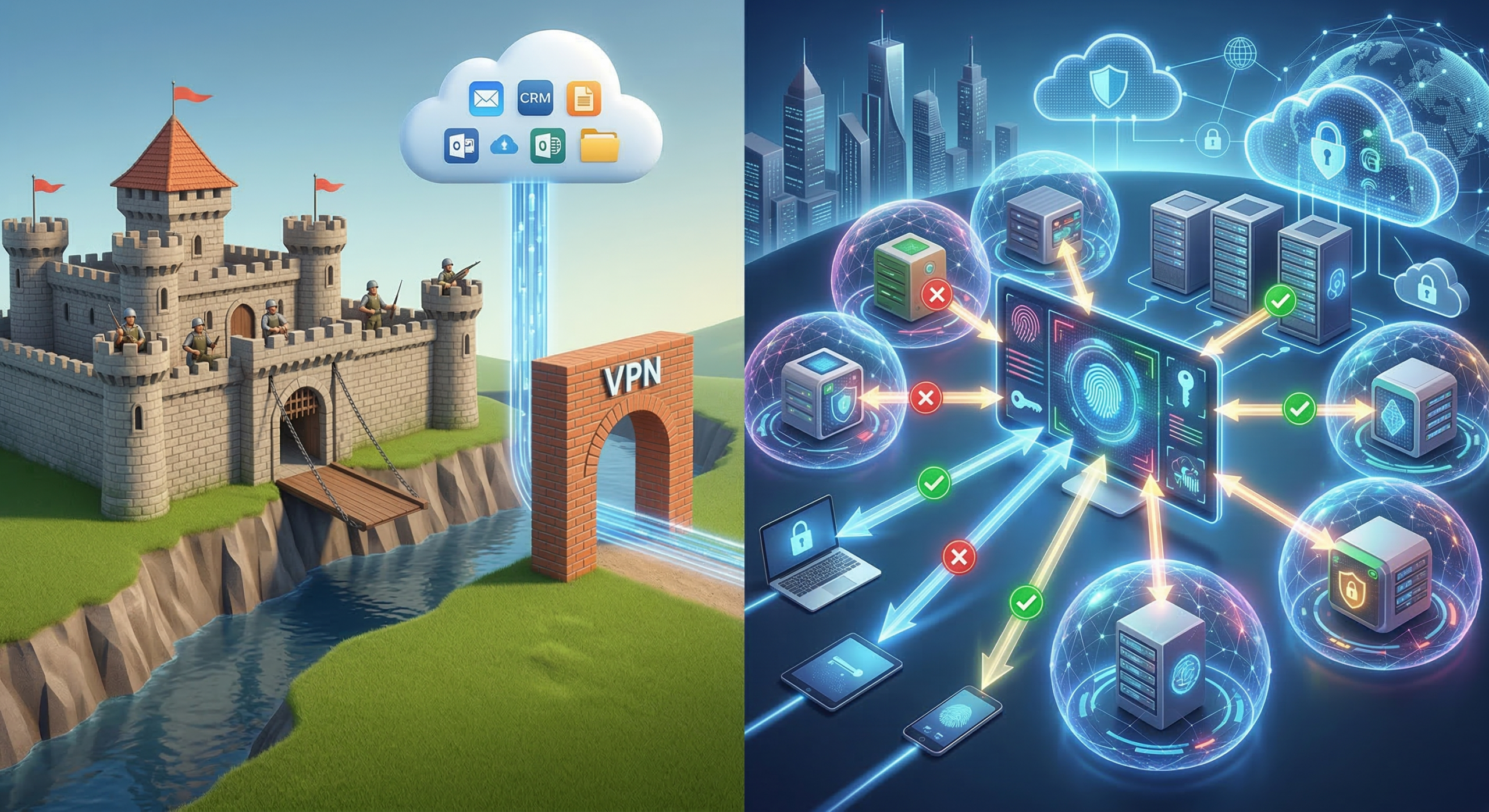
The issue isn’t that VPNs are inherently bad, but rather that the landscape they were designed to protect has fundamentally changed. Today’s reality demands a more dynamic, granular, and inherently skeptical approach to security. This is where Zero Trust architecture steps in, not just as a replacement for VPNs, but as a paradigm shift in how we think about network security.
The Limitations of the VPN Castle
VPNs create a encrypted tunnel between a user’s device and the corporate network. Once authenticated, the user’s device effectively becomes part of the internal network, often with broad, implicit trust.
Here’s why this model is increasingly problematic:
- Static Security: Authentication usually happens once, at the beginning of the session. A compromised credential or a device that becomes infected after connecting remains trusted until the session ends.
- Lack of Granularity: VPNs often provide network-level access rather than application-level access. Once “on the network,” a user might have visibility into resources they don’t actually need, increasing the risk of lateral movement if their account is compromised.
- User Experience Challenges: Backhauling all traffic through a central VPN concentrator can lead to latency and performance issues, especially for remote users connecting to cloud resources that are geographically distant from the VPN gateway.
- Ineffective Against Modern Threats: VPNs are primarily designed to keep external attackers out. They offer limited protection against threats that originate inside the network (malicious insiders) or that successfully breach the perimeter (using stolen credentials).
Enter Zero Trust: “Never Trust, Always Verify”
Zero Trust is not a single product or service, but a security framework built on a fundamental principle: no entity, whether inside or outside the network, should be trusted by default. Instead, trust must be established dynamically and continuously verified for every single request to access a resource.
Here’s how Zero Trust flips the traditional security model on its head:
1. Verification for Every Request, Not Every Session
Forget “log in once and have free rein.” Zero Trust requires strong authentication (often with Multi-Factor Authentication, MFA) for every attempt to access applications, data, or systems. Access decisions are based on the specific context of that request, not just pre-defined user permissions.
2. Context-Aware Access Controls
Zero Trust systems consider a wide range of real-time contextual factors before granting access:
- Identity: Who is making the request? (Strong MFA is non-negotiable).
- Device Health: Is the device managed? Is its OS up-to-date? Does it have active malware infection?
- Application/Service: What specific resource is being accessed? Access should be limited to only what is necessary.
- Location/Network: Where is the request coming from? Is it an unusual location or a known malicious IP address?
- Time of Request: Is the access happening outside of normal working hours?
3. Application-Level Access, Not Network-Level Access
Unlike VPNs that give network access, Zero Trust focuses on granting access to specific applications or services. Users (or devices, or service accounts) are connected directly and securely to the application they need, without ever being granted visibility into the underlying network infrastructure or other applications. This dramatically reduces the potential for an attacker to move laterally within your network.
4. Continuous Risk Assessment
Zero Trust doesn’t stop at authentication. It continuously monitors user behavior and device posture throughout the session. If any risk indicators change (e.g., the device becomes infected with malware, unusual data transfer activity is detected), access can be revoked immediately or additional verification requested.
Why Zero Trust is the Future of Secure Access
The transition from VPNs to a Zero Trust architecture provides numerous benefits:
- Significantly Enhanced Security: By eliminating implicit trust, Zero Trust minimizes the attack surface and prevents unauthorized access, lateral movement, and data breaches.
- Adaptable to Modern Workforces: Seamlessly secures access for remote workers, contractors, and third-party partners connecting from any location and device.
- Better Protection for Cloud Environments: Provides granular, application-level control for accessing resources hosted across public, private, and hybrid clouds.
- Improved User Experience: Enables faster, direct connections to cloud applications, eliminating the latency and bottlenecks associated with VPN backhauling.
The Road Ahead: Starting Your Zero Trust Journey
Migrating to a Zero Trust architecture is a journey, not a switch you flip. It requires a strategic approach that involves people, processes, and technology.
- Identify Critical Assets: Start by understanding your most sensitive applications, data, and users.
- Enforce Strong Authentication: Implement MFA across all systems and applications.
- Implement Application-Level Access Control: Explore technologies like Zero Trust Network Access (ZTNA) solutions to grant secure access to specific applications.
- Continuously Monitor and Adapt: Gain visibility into user behavior and device health, and use this data to refine your security policies.
The era of trusting anyone inside your network is over. In today’s interconnected and treacherous digital world, adopting a “never trust, always verify” mindset is not just a best practice—it’s essential for survival. Ditch the leaky moat and embrace the dynamic, granular, and context-aware protection offered by Zero Trust security.

